NICL zero depreciation cover alloy wheels is a common question for car owners who have upgraded wheels or added accessories. The direct answer is simple: NICL’s Nil Depreciation Plus does not automatically cover alloy wheels or accessories unless they are specifically included in the policy schedule with a separate IDV.
That is why many claims get confusing. People expect zero depreciation to work like full bumper-to-bumper protection, but NICL’s wording is narrower. It covers depreciation on eligible parts in an admissible partial loss claim, while accessories and extra fittings are excluded unless separately insured.
Does NICL zero depreciation cover alloy wheels?
NICL’s policy terms say the insurer will indemnify loss or damage to the vehicle insured and its accessories, but the nil-depreciation add-on itself has limits. The add-on applies to partial loss claims and stops after the first two admissible partial loss claims in the policy period.
The key point is this: alloy wheels are not always treated as standard covered parts. If they are aftermarket, upgraded, or separately fitted, they usually fall into the accessory category. NICL specifically says it is not liable for depreciation on accessories, extra fittings, or internal improvements unless they are covered under a separate IDV.
So the answer depends on how your policy was written. If the wheels are declared and included properly, you have a stronger case. If not, zero depreciation alone is not enough.
Does NICL zero depreciation cover accessories?
Usually, no. NICL’s wording is direct on this point. Accessories and extra fittings are excluded from depreciation relief unless they are insured separately.
This matters for many Indian cars because buyers often add infotainment systems, body kits, chrome trims, alloy wheels, and premium lighting after purchase. If these items are not declared, they may not get the protection you expect during a claim.
The practical rule is easy. Factory-fitted items are safer than aftermarket upgrades, but even then, the schedule must match the car’s actual configuration. For any major add-on, check whether your policy shows separate IDV or endorsement.
What NICL nil depreciation plus actually covers
NICL Nil Depreciation Plus is designed to reduce your out-of-pocket expense on eligible accident repairs. In simple terms, it helps when parts need replacement and depreciation would normally reduce the claim payment.
NICL also notes that depreciation on parts like rubber, nylon, plastic, and tyres follows the main policy structure unless the add-on changes that outcome for admissible claims. The policy wording also makes clear that the add-on is not a blanket promise for every damage type.
This is why zero dep is valuable for accident repairs, but it does not turn every wheel or accessory loss into a full payout. Theft, wear and tear, and undeclared modifications remain problem areas.
Zero depreciation vs tyre and alloy cover
These two covers are not the same. Zero depreciation is a claim-settlement add-on for eligible accident repairs. Tyre and alloy cover is a more specific add-on meant to address wheel and tyre-related damage scenarios.
That difference matters on Indian roads, where potholes, curb hits, and rim bends are common. A zero-dep policy may help with approved replacement costs, but a dedicated tyre-and-alloy cover is often better for wheel-specific losses.
If your main concern is expensive alloy wheels, you should think in layers. First, make sure the accessory is declared. Then check whether you need a separate wheel-focused add-on as well.
Real claim scenarios
If an accident damages a factory-fitted alloy wheel and the claim is admissible, zero depreciation may help by removing depreciation on eligible replacement parts. That is the best-case scenario for a properly insured car.
If the alloy wheel is aftermarket and not declared, the claim becomes risky. NICL’s wording on accessories and separate IDV becomes the deciding factor. Learn more about NICL TP claim meaning and processes.
If the issue is cosmetic scratching, routine wear, or pre-existing damage, zero dep is not a magic repair pass. Many insurers exclude those situations, and third-party guides also warn that zero dep is meant for repair or replacement after a covered event.
How to check your NICL policy
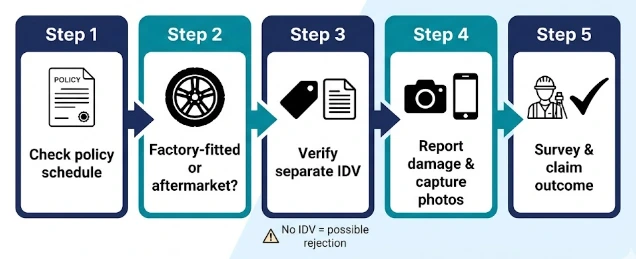
Start with the policy schedule. That is where IDV, vehicle details, and any accessory value should appear. Download your NICL policy to verify this easily. NICL’s documents treat the schedule as the core reference for coverage and valuation.
Next, check whether your accessories were declared at the time of purchase or renewal. If you added alloys later, ask whether they were endorsed and whether a separate IDV was set. Fix issues via NICL policy renewal guide.
Finally, confirm whether you have already used two partial loss nil-dep claims in the same policy period. NICL’s wording limits the add-on to the first two partial loss claims.
What not to do
Do not assume “zero depreciation” means every item on the car is protected. The policy wording is more specific than the market nickname.
Do not install expensive accessories and ignore policy disclosure. Undeclared fittings often become claim trouble later.
Do not confuse zero depreciation with tyre-and-alloy protection. They solve different problems and may both be needed. Contact NICL customer care for clarification.
Quick checklist
- Check if alloy wheels are factory-fitted or aftermarket.
- Read the schedule for separate accessory IDV.
- Confirm that NICL Nil Depreciation Plus is active. Use the NICL insurance claim form for reference.
- Ask for endorsement in writing for any new fitting.
- Verify claim limits before renewal.
Not automatically. Alloy wheels need to be covered properly in the schedule or through separate IDV.
Usually not. NICL excludes accessories and extra fittings unless separately insured.
Yes, declaring them improves the claim position because the policy can reflect them correctly.
No. Tyre and alloy cover is a separate add-on for wheel-focused damage.
No. NICL’s Nil Depreciation Plus excludes losses arising from theft.
Yes, if the claim is admissible and the item is properly covered.
Conclusion: NICL zero depreciation is useful, but it is not a blanket cover for alloy wheels and accessories. The policy wording shows that accessory protection depends on separate IDV and proper disclosure.
For Indian car owners, the safest approach is simple: check the schedule, declare upgrades, and do not confuse nil depreciation with wheel-specific protection.